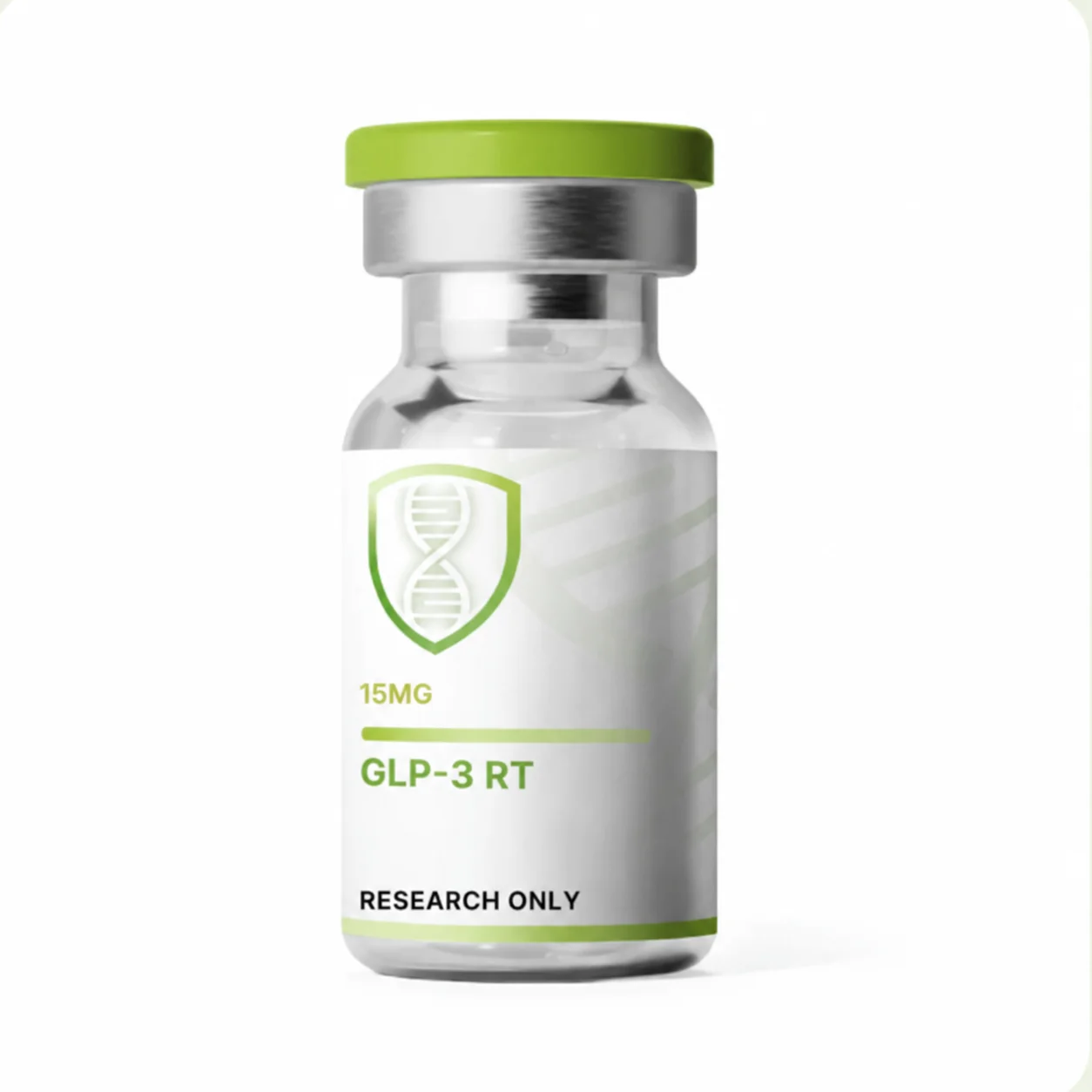
GLP-3 RT
15 mg
GLP-3 RT 15 mg is a synthetic research peptide intended for laboratory studies involving GLP-1, GIP, and glucagon receptor signaling. Researchers can use this material to investigate receptor interactions, GPCR signaling, intracellular pathways, and peptide pharmacology.
Bulk Pricing - Save More!
Overview
Buy GLP-3 RT 15 mg
GLP-3 RT 15 mg is a synthetic research peptide intended for laboratory studies involving GLP-1, GIP, and glucagon receptor signaling. Researchers can use this material to investigate receptor interactions, GPCR signaling, intracellular pathways, and peptide pharmacology.
For Research Use Only. Not for Human or Veterinary Use.
GLP-3 RT 15 mg at a Glance
| Characteristic | Details |
| Name of the product | GLP-3 RT |
| Quantity | 15 mg |
| Product Type | Research peptide |
| Research Focus | GLP-1, GIP, and glucagon receptor signaling |
| Primary Receptors | GLP-1R, GIPR, GCGR |
| Physical Form | Lyophilized powder |
| Research Application | Laboratory research |
| Testing | HPLC and mass spectrometry |
| Documentation | Batch-specific COA |
| Use Classification | Research Use Only (RUO) |
| Storage | -20°C for long-term stability |
What Is GLP-RT 15 mg?
GLP-3 RT 15 mg is a research peptide designed for laboratory investigation of related peptide hormone receptor pathways.
Its primary research focus is the GLP-1 receptor (GLP-1R), GIP receptor (GIPR), and glucagon receptor (GCGR). These receptors belong to the class B GPCR family and participate in distinct intracellular signaling pathways.
This makes GLP-RT relevant to research involving:
- GLP-1 receptor signaling
- GIP receptor signaling
- Glucagon receptor signaling
- GPCR pharmacology
- cAMP signaling
- Ligand-receptor interactions
- Peptide structure-function studies
- Comparative receptor research
GLP-1 Receptor Research
The GLP-1 receptor (GLP-1R) is a class B GPCR that plays an important role in multiple intracellular signaling pathways.
Lab research can explore the interaction between GLP-1R and various peptide ligands as well as the impact of receptor activation on downstream signaling cascades.
The following areas of study can be considered:
- GLP-1R binding
- Receptor activation assays
- cAMP signaling research
- GPCR pharmacology
- Cellular signaling studies
GIP Receptor Research
The GIP receptor (GIPR) is another class B GPCR that is also involved in peptide hormone signaling transduction.
Researchers can analyze the function of GIPR as an independent receptor or compare the signaling mechanisms of GIPR and GLP-1R.
Potential research areas may cover:
- GIP receptor binding
- GIPR activation studies
- cAMP response assays
- Receptor pharmacology
- Comparative peptide research
Glucagon Receptor Research
The glucagon receptor (GCGR) represents another class B GPCR that can serve as a valuable research model.
By studying interactions between GCGR and various ligands, scientists can obtain important insight into the mechanisms of peptide-receptor interaction and intracellular signaling.
Research involving GCGR may include:
- Receptor-ligand interactions
- GCGR activation
- cAMP signaling
- GPCR signaling pathways
- Comparative receptor pharmacology
GLP-1, GIP, GLP-2, and Glucagon: Understanding the Difference
GLP-1, GIP, GLP-2, and glucagon are related peptide hormones, but they have distinct receptors and biological signaling pathways.
GLP-1 signals primarily through GLP-1R, GIP through GIPR, glucagon through GCGR, and GLP-2 through GLP-2R.
These receptors belong to the broader class B GPCR family, making them useful subjects for comparative receptor and signaling research.
For accuracy, GLP-2 should not be listed as a GLP-RT receptor target unless batch-specific or product-specific evidence establishes GLP-2R activity.
Why Study Multiple Peptide Receptor Pathways?
Studying related peptide receptors can help researchers examine differences in receptor activation, ligand selectivity, and downstream signaling.
Research involving GLP-1R, GIPR, and GCGR can therefore support investigations into:
- Receptor pharmacology
- GPCR signaling
- Ligand selectivity
- Intracellular signaling
- Peptide-receptor interactions
- Structure-function relationships
- Multi-receptor research models
The broader field of metabolic peptide research continues to examine receptor biology, signaling cascades, and interactions between related hormone pathways. Orion’s Metabolic Research hub provides additional research-oriented material on peptide signaling and metabolic pathways.
GLP-RT 15 mg Research Applications
GLP-RT 15 mg may be investigated in appropriate laboratory models involving:
- Receptor binding assays
- GPCR activation studies
- cAMP signaling research
- Ligand-receptor interaction studies
- Cell-based research
- Peptide pharmacology
- Comparative receptor studies
- Multi-receptor signaling research
Experimental concentration, assay conditions, and methodology should be selected according to the research model and validated laboratory protocols.
GLP-3 RT 15 mg Testing and COA
Analytical documentation is an important part of evaluating research peptide materials.
Depending on the actual batch, analytical testing may include high-performance liquid chromatography (HPLC) and mass spectrometry (MS).
HPLC can provide information about chromatographic purity, while mass spectrometry can support molecular identity.
What Researchers Should Check on the COA
A batch-specific Certificate of Analysis should ideally allow researchers to connect the analytical results with the material they received.
Relevant information can include:
- Product name
- Batch or lot number
- Testing date
- HPLC results
- Mass spectrometry results
- Testing laboratory
- Analytical specifications
- Reported results
Always review the COA for the specific GLP-RT 15 mg batch rather than relying solely on a general product-page purity claim.
Why Choose GLP-3 RT 15 mg for Research?
GLP-RT 15 mg offers researchers a well-characterized peptide to study GLP-1R, GIPR, and GCGR signaling in a laboratory setting.
An informative research product page should provide researchers with all the information they need to know about:
- Product identity
- Research targets
- Quantity
- Physical form
- Analytical testing
- Availability of a COA
- And intended research use
This information is important to enable researchers to make an informed choice when selecting a product for their research.
Research Use Only
GLP-3 RT 15 mg is supplied exclusively for laboratory research and development.
It is not intended for human consumption, veterinary use, clinical use, diagnosis, treatment, or prevention of disease.
For Research Use Only. Not for Human or Veterinary Use.
Frequently Asked Questions
1. What is GLP-RT 15 mg?
GLP-RT 15 mg is a research peptide related to GLP-1, GIP, and glucagon receptor signaling.
2. What receptors are associated with GLP-RT research?
The primary research focus is GLP-1R, GIPR, and GCGR.
3. Does GLP-RT target GLP-2?
GLP-2 has another receptor known as GLP-2R. It should not be listed as a GLP-RT target unless shown in the product itself.
4. What is GLP-RT 15 mg used for?
It is used purelyfor research in laboratories relating to peptide-receptor interaction, GPCR signaling, receptor pharmacology, and related cellular pathways.
5. Is GLP-RT 15 mg for human use?
No, it is strictly for research purposes and not for human or veterinary use.
Conclusion
GLP-RT 15 mg is a research peptide related to GLP-1R, GIPR, and GCGR signaling. The related class B GPCR pathways are useful models for investigating receptor interactions, intracellular signaling, cAMP activity, and peptide pharmacology.
For researchers evaluating using GLP-3 RT 15 mg as laboratory research material, analytical documentation and product information on a batch-specific basis will help support experimental planning. GLP-2 and its receptor should be treated separately since GLP-2R represents another receptor altogether.
GLP-RT 15 mg is strictly for laboratory research and not for human or veterinary use.
References
Research Applications
- Biochemical mechanism studies
- Cell culture research
- In vitro assay development
- Structural biology investigations
Research Use Only
This product is intended for laboratory research use only. It is not intended for human or animal consumption, or for use in diagnostic or therapeutic procedures.